
In today’s fast-paced business landscape, efficiency and visibility in sales operations are more critical than ever. Sales teams, operations staff, and service departments often struggle with disconnected systems—one for customer relationship management, another for quoting, and yet another for order fulfillment. ServiceNow’s Sales and Order Management (SOM) platform is a game-changer designed to unify these processes. Built on ServiceNow’s Now Platform, SOM connects the entire lead-to-cash lifecycle on a single cloud platform, helping organizations sell, quote, and fulfill orders on a unified system while accelerating revenue, improving productivity, and reducing costs ( What’s New in the Yokahama (Q1 ’25 Store) release … – ServiceNow Community ). In this introduction, we’ll explore what SOM is, its key features, and how it delivers business value by transforming sales operations. We’ll also look at real-world examples to illustrate SOM in action.

What is ServiceNow Sales and Order Management (SOM)?
ServiceNow SOM is an integrated suite of applications that manages the product sales life cycle from initial lead to order fulfillment and beyond. It lives within the broader ServiceNow ecosystem of digital workflow solutions, leveraging the same Now Platform used for IT, customer service, and other enterprise workflows. This means SOM seamlessly integrates with modules like Customer Service Management (for support cases) and Field Service Management (for on-site services), as well as with ServiceNow’s AI and workflow engines. The result is a single system of action where sales, finance, operations, and customer service teams all work off the same data and processes, eliminating silos and hand-offs between disparate tools.
At its core, SOM is not a traditional CRM replacement but rather a complementary platform focused on automating and connecting the end-to-end “lead-to-cash” process. It starts with capturing sales leads and opportunities, moves through quoting and contract management, handles order capture and fulfillment, and even covers post-sale services like changes or renewals. In other words, ServiceNow SOM provides “one platform for enterprise automation” of the sales and order lifecycle, where quotes flow directly into orders, and every step is part of a unified workflow. This unified approach stands out from many sales solutions that address only pieces of the process. As one industry observer noted, ServiceNow’s SOM offers powerful, mature functionalities covering the entire sales lifecycle—from lead generation to CPQ (configure-price-quote) and order management—where few other solutions deliver a comprehensive suite for large enterprises.
Key Features of ServiceNow SOM
ServiceNow SOM includes a rich set of features and applications that together enable full control over the sales and order process. Some of its key features and capabilities include:
- Product Catalog Management: Maintain a centralized product and service catalog, supporting complex products, bundles, and combined offerings. This commercial catalog is easily configurable, ensuring sales teams and customers always access up-to-date offerings. An integrated technical catalog can mirror the commercial catalog for fulfillment, so that what is sold can be delivered without manual translation.
- Product Configurator (CPQ): A built-in configure-price-quote engine allows sales reps or customers to configure complex product and service bundles quickly and accurately. The configurator applies pricing rules, discounts, and compatibility checks in real time. This replaces the need for separate CPQ software and prevents errors by ensuring only valid combinations and pricing go into a quote.
- Pricing Management: Support for diverse pricing models—one-time charges, recurring subscriptions, volume or tiered pricing, account-specific pricing, and multi-currency models are all handled in SOM. This flexibility is crucial for businesses with subscription services or global customers, allowing consistent pricing strategies within the platform.
- Lead and Opportunity Management: Track the lead-to-opportunity funnel natively in ServiceNow. SOM provides tools to capture leads (e.g., from web forms or marketing), qualify them, and convert them into sales opportunities. Sales teams can manage their pipeline, record activities (calls, emails, meetings), and collaborate on opportunities in real time. This ensures that no potential deal falls through the cracks and provides sales leaders with visibility into pipeline health.
- Quote Management: Generate professional quotes and proposals, including multiple quote revisions and approvals. SOM can automatically convert an approved quote into a sales order, ensuring a seamless handoff from sales to fulfillment. Sales agreements or proposals can be captured, and with Contract Management (see below), even legal contract documents can be produced from the quote. The platform also supports quote templates and electronic signatures for efficiency.
- Contract Management: With Contract Management Pro capabilities, users can create or generate legal sales contracts directly from approved quotes using prebuilt workflows. This streamlines the transition from a customer saying “yes” to a signed agreement without manual document drafting. Contract terms and customer entitlements (like support SLAs or renewal dates) are tracked in the system for future use.
- Order Management: At the heart of SOM is robust order management that connects the entire order lifecycle from capture to fulfillment. When an order is placed (either by a sales rep or via customer self-service), SOM kicks off workflow-driven fulfillment tasks. It can create tasks for various teams (finance, provisioning, shipping, etc.), assign them, and track the progress through completion. This ensures on-time delivery and eliminates the need for separate order entry in an ERP system. Fallout management features help identify and resolve any order issues or errors so orders can be processed to completion .
- Self-Service Portal for Orders: A customer-facing Self-Service Portal allows business customers to independently configure, place, and track orders without needing direct sales involvement. Through a web portal (often an extension of a company’s ServiceNow Customer Service portal), customers can browse the product catalog, build their own quote or order by selecting and configuring products, and submit orders which enter the SOM workflow for approval and fulfillment. They can also track order status in real time. This not only improves customer experience but also reduces the burden on sales and support teams for routine transactions.
- Location-Based Transactions: SOM supports complex sales to organizations with multiple sites or locations. Sales reps (or customers) can create opportunities, quotes, and orders that are tailored to one or more customer locations. This is especially useful for industries like telecom or franchise-based businesses, where a single customer might be buying services for dozens of locations – SOM can consolidate that into one process while still distinguishing each location’s details.
- Customer Lifecycle Workflows (MACD): Beyond initial orders, SOM enables management of post-sale changes using Move, Add, Change, Disconnect (MACD) workflows. For example, if a customer wants to upgrade a service, add a new component, suspend or resume a service, or cancel something, the sales or service agent can easily execute these changes through guided workflows. This ensures that changes to existing customer products or subscriptions are handled consistently and all downstream systems (billing, provisioning, etc.) are updated.
- Customer Contracts and Entitlements: The platform also tracks customer contracts, renewals, and entitlements for services. This means when it’s time for a renewal or if a customer requests a change that affects their contract, the SOM system knows the current contract terms and can facilitate updates or upsells. It empowers customer service or account managers to provide post-sales support and pursue renewals or extensions proactively, all in the same system that handled the initial sale.
- Analytics and AI-Powered Recommendations: Because SOM is on the Now Platform, it can utilize built-in AI and analytics to enhance sales operations. For instance, the system can provide product recommendations to sales agents during quoting (based on what’s in the cart or what similar customers purchased) to drive cross-sell and upsell opportunities. It also offers actionable insights and dashboards for managers to spot bottlenecks or trends. Everyone gets the information they need to make smarter decisions thanks to a single data model that gives full visibility across the sales and order environment.
- Workflow and Integration: ServiceNow SOM leverages the platform’s Flow Designer (a low-code, drag-and-drop process automation tool) to automate manual steps and orchestrate processes across different departments. It can also integrate with external systems via APIs – for example, pulling in leads from a marketing system, sending orders to an ERP for billing, or integrating with e-signature tools for contracts. Since all modules run on the same platform, SOM can natively talk to ITSM, CSM, or any other ServiceNow module, ensuring end-to-end continuity. This extensibility means companies can adapt SOM to their unique legacy environment; it’s designed to work alongside existing CRM or ERP systems if needed.
Business Benefits of Using SOM
Adopting ServiceNow’s Sales and Order Management brings a number of significant business benefits:
- Faster Time to Market: Organizations can launch new products and services more quickly by using an integrated catalog and automated workflows. Instead of lengthy IT projects to update multiple systems for a new offering, companies can configure it once in SOM (with both sales and fulfillment details) and start selling immediately. This agility is crucial in industries where being first can capture market share.
- Shorter Sales Cycles & Time to Revenue: By connecting and automating traditionally siloed processes – from lead, to quote, to order fulfillment – on one platform, SOM eliminates delays and manual hand-offs. Sales orders flow directly and instantly to fulfillment teams; there’s no re-entering data or waiting on emails. This means deals get closed and delivered faster, translating into quicker revenue recognition. One global telecom provider, for example, saw complex order processing time drop from 3 days to under 1 minute after streamlining with ServiceNow (KPN – ServiceNow – Customer Story ).
- Increased Sales Efficiency & Productivity: Sales operations teams and agents become far more productive when repetitive tasks are automated and information is centralized. SOM automates quote calculations, approvals, task assignments, and more, freeing teams to focus on selling and customer relationships. With a 360° view of the customer and process, reps spend less time searching for data or status updates. According to ServiceNow, companies using SOM have dramatically reduced manual workload – for instance, Kraft Heinz “slashed the number of manual order touches and exceptions” by automating order handling on the platform.
- Improved Accuracy and Fewer Errors: Automation and a single system reduce the human errors that often plague sales order processing (like pricing mistakes or missing information). The product configurator ensures only valid combinations are sold; automated workflows ensure no step is overlooked. Order fallout (orders that fail or need rework due to errors) goes down significantly. KPN, a European telecommunications company, unified its order management on ServiceNow and reduced order fallout from 7% to under 1% (KPN – ServiceNow – Customer Story ) by using catalog-driven fulfillment (eliminating custom one-off processes).
- Better Customer Experience: SOM enables a smoother journey for the customer from the moment they express interest to post-sale support. Customers benefit from faster quotes, more accurate orders, and on-time delivery, which builds trust. The ability for customers to self-serve for placing orders or checking status provides transparency and convenience. And when customers need changes or help, service agents have all the context (from the original sale to the latest entitlement) at their fingertips. This leads to higher customer satisfaction and loyalty. For example, one company improved its order fulfillment speed by 50% and saw a 60% increase in customer satisfaction scores after implementing ServiceNow SOM.
- Unified Data and Visibility: Because all sales and order data resides in one platform, managers and executives gain real-time visibility into sales performance, order backlog, and potential issues. Dashboards can show the entire funnel from leads to active orders to renewals. This helps in forecasting and identifying trends or bottlenecks early. A single data model also means reports and analytics are drawing from one source of truth, improving decision-making quality.
- Cost Reduction: Streamlining processes not only speeds them up but also cuts operational costs. Fewer systems to maintain, less manual work, and faster onboarding of new products all contribute to a lower cost of sales. Automation reduces the need for expediting or firefighting orders. Some organizations have reported significant efficiency gains – for instance, ATN International achieved a 33% productivity gain in its sales operations and cut order fulfillment time from hours to under a minute by using ServiceNow’s unified approach. These efficiencies ultimately improve the bottom line.
- Stronger Cross-Team Collaboration: With front-office (sales) and back-office (delivery, finance, support) activities managed in one workflow, teams collaborate more naturally. There is “one record” of the truth for each deal or order, which everyone can access according to their role. This breaks down the historical wall between sales and operations. A COO using SOM gains the ability to connect multiple siloed processes and reduce reliance on disconnected tools, making the organization more nimble. In practice, this means fewer status meetings and emails—everyone from the sales rep to the fulfillment coordinator to the customer support agent is looking at the same live order status.
- Greater Agility and Innovation: Because SOM is highly configurable (with low-code tools) and part of a broader platform, companies can continuously refine their sales workflows. They can respond to new business models (e.g., pivot to subscription services) or integrate acquisitions more easily by adjusting the processes in ServiceNow instead of wrangling multiple systems. The platform’s regular upgrades and feature additions (like new AI capabilities or portal enhancements) ensure that the sales process can keep evolving with the business.
How SOM Streamlines and Transforms Sales Operations
Implementing ServiceNow SOM can fundamentally transform sales operations by streamlining the end-to-end process. Traditionally, enterprises have separate systems for CRM (tracking leads and opportunities), CPQ, order entry, and customer service. These silos cause breaks in the process – sales reps might close a deal, then email an order form to operations, where data is re-entered into an order system, and later customer service may not have visibility into what was sold. SOM replaces this fragmented flow with one continuous workflow on the Now Platform.
From Lead to Cash on one platform: In SOM, a sales journey can start as a lead, convert to an opportunity, progress to a quote, and then become an order – all without leaving ServiceNow or duplicating data. Each stage is essentially a status change in a unified pipeline. For example, when a quote is accepted, SOM automatically generates the order record with all the necessary details from that quote (products, prices, customer info), kicking off fulfillment tasks instantly. This removes lag time completely. Moreover, because all teams (Sales, Finance, Delivery, Support) are working in the same environment, front-office and back-office teams stay aligned every step of the way. The platform connects these roles so tightly that it can “bridge the gap” many companies have between sales and delivery – a gap that historically has been complex to close. By closing this gap, SOM ensures that what Sales sells, Operations can deliver, and any exceptions are handled collaboratively and efficiently.
Workflow-driven order fulfillment: A major transformation comes in the order fulfillment phase. Instead of sending emails or tickets to fulfillment teams, SOM uses intelligent workflows to orchestrate fulfillment across departments. For instance, if a telecom company sells a new connectivity service to a client, once the order is submitted, SOM might automatically create tasks for the network provisioning team, the billing team (to set up invoicing), and the customer support team (to schedule a welcome call). Each task is tracked within the same order record. If any task encounters an issue (say a component is out of stock or a credit check fails), the system can flag an exception (often called fallout) and route it to the appropriate team to resolve. Managers have visibility into the status of all orders in progress and can ensure nothing gets stuck. This level of process orchestration transforms what used to be a chaotic, manual process into an efficient assembly line for fulfilling orders.
Integrated post-sale service: SOM doesn’t stop at order delivery; it transforms post-sales operations as well. All the customer’s purchased products and services are recorded in ServiceNow, so if the customer needs changes or has an issue, the support team uses the same system to help them. For example, if a client calls to upgrade their subscription, a support agent can use SOM’s Customer Lifecycle Workflows to process that change order immediately, with tasks auto-generated for any provisioning updates. Even billing disputes or invoice issues can be managed through SOM’s case management for invoice operations. ServiceNow recently introduced features to allow the creation of invoice dispute cases linked to orders/invoices, so billing exceptions can be tracked and resolved just like any support case ( What’s New in the Yokahama (Q1 ’25 Store) release … – ServiceNow Community ) ( What’s New in the Yokahama (Q1 ’25 Store) release … – ServiceNow Community ). This means sales operations extend into revenue assurance and customer retention, all in one place. Such end-to-end continuity significantly improves the customer’s experience (they don’t get bounced between departments) and internal efficiency (each team sees the full context).
Self-service and omni-channel engagement: Another way SOM streamlines operations is by enabling self-service channels for customers and partners. Instead of a salesperson having to manually take every order, SOM’s self-service portal (or a commerce portal) allows customers to serve themselves for many transactions. As shown below, a customer can configure a complex order (choosing products, adjusting quantities, seeing pricing instantly) and submit it directly into the workflow – no phone call or email needed. They can also track their order status without calling support, which reduces inbound inquiries. This 24/7 availability of a portal can significantly increase order volume and reduce latency in the sales process, especially for repeat or low-touch sales.
Screenshot: A ServiceNow self-service Commerce Portal where a B2B customer builds a cart of products and services. Customers can configure product bundles (like a “Home Automation Bundle” with various devices), see pricing (one-time and recurring), and submit the order directly. SOM then creates a draft order for an agent to review and fulfill, while the customer can monitor the order status online.

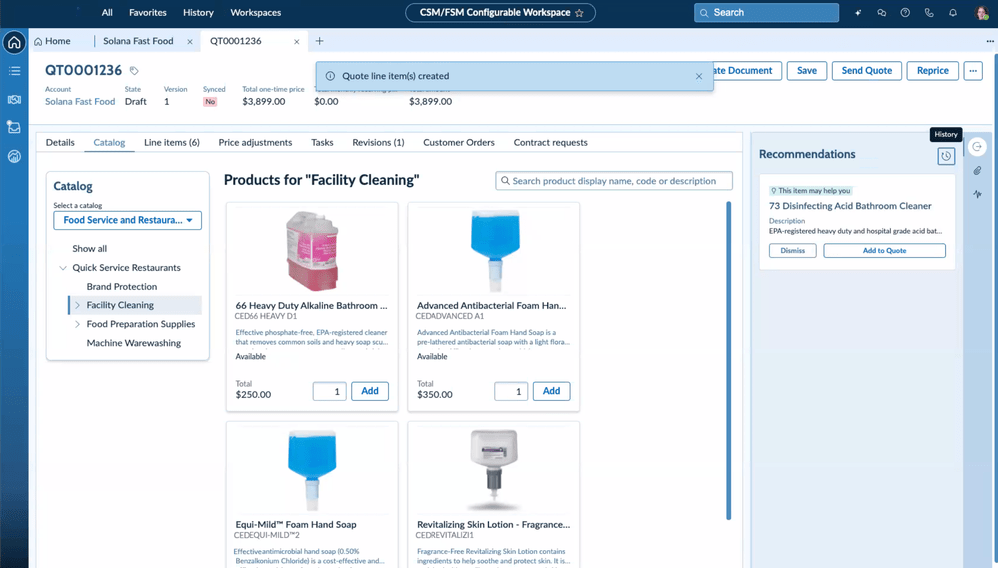
Guided selling and AI assistance: SOM also transforms the effectiveness of sales operations by embedding intelligence into the process. For instance, when a sales agent is configuring a quote for a customer, the system can suggest relevant add-on products or services. This is accomplished through contextual product recommendations – an AI-driven feature that looks at the current quote contents (or similar customers’ purchase history) and recommends items to upsell. This guided selling approach not only can increase deal size (benefiting revenue) but also helps new sales reps ramp up faster, since the system guides them on what to offer. In the screenshot below, you can see an example of SOM’s agent workspace showing a product catalog for “Facility Cleaning” products and, on the right side, a Recommendations panel suggesting an additional item to add to the quote (e.g., a disinfecting cleaner that “may help you”). These kinds of features streamline decision-making and ensure no sales opportunity is missed.
Screenshot: Sales Agent Workspace in ServiceNow SOM. The agent is configuring a quote (QT0001236) for a customer, browsing a product catalog (middle panel) organized by categories (e.g., Facility Cleaning). On the right, an AI-driven Recommendations panel suggests related products (“This item may help you – Disinfecting Bathroom Cleaner”) that the agent can add with one click. Such contextual recommendations help increase revenue and improve sales efficiency.
Finally, by running on ServiceNow’s Now Platform, SOM brings all the platform-level advantages to sales operations. These include built-in security and access controls (important for protecting customer and deal data), audit trails for all changes (useful for compliance and tracking sales commitments), and the ability to create custom apps or extensions if needed. For example, a company could build a custom approval workflow (via Flow Designer) for high-value deals that require CFO sign-off, or integrate a third-party tax calculation service for orders in various jurisdictions. The unified platform means these enhancements plug into the existing data and UI seamlessly. As a result, SOM is not a rigid out-of-the-box tool, but a flexible platform that can adapt to each organization’s sales processes while enforcing best practices.
Real-World Use Cases and Success Stories
ServiceNow’s Sales and Order Management is relatively new but is already delivering results in various industries, from telecommunications to manufacturing to technology providers. Let’s look at a few real-world examples and scenarios that demonstrate its impact:
- Telecommunications Order Orchestration (KPN): KPN, a major telecom provider in the Netherlands, faced the challenge of complex service orders that spanned multiple legacy systems. By implementing ServiceNow for order management (as part of an industry solution), KPN dramatically streamlined its process. They went from using 15 custom tables for order handling down to zero, fully relying on ServiceNow’s catalog and workflow. The impact was striking – complex orders that used to take 3 days to process are now completed in under one minute, and the order fallout rate (orders that fail or need manual correction) dropped from 7% to under 1% (KPN – ServiceNow – Customer Story ). This means nearly every order goes through on the first try, which in turn improves customer satisfaction and reduces operational workload. KPN’s long-term vision is to extend this to full customer self-service: allowing B2B customers to log into a portal, customize their own telecom solutions, get an instant quote, and have the order fulfilled automatically – a goal that SOM is well-positioned to achieve.
- Manufacturing & CPG (Kraft Heinz): For a company like Kraft Heinz, managing orders might involve coordinating between sales teams, distributors, and production. While specific metrics aren’t published in this case, ServiceNow highlights that Kraft Heinz “slashed the number of manual order touches and exceptions” after implementing SOM We can infer that before SOM, many orders required manual intervention (phone calls, emails to fix issues or expedite), but with automated workflows and better data integration, most orders flow through without needing human fixes. This kind of streamlining is crucial in high-volume businesses where even small efficiency gains can save thousands of person-hours and ensure customers (like retailers stocking Kraft Heinz products) get their orders on time.
- High-Tech & XaaS Provider: One of the target audiences for SOM is high-tech companies offering XaaS (Anything-as-a-Service) subscriptions. Consider a software-as-a-service company that needs to manage trial leads, convert them to paying customers, handle complex quotes for enterprise licensing, and then automate provisioning and customer support. With SOM, the lead from marketing can be directly assigned to a salesperson in the platform, the salesperson can use guided selling to configure the right package, and once the customer signs off, the system can trigger user account creation, send out welcome emails, and create an entitlement record for support. All of these steps happen without the sales team ever leaving ServiceNow. This greatly reduces friction between Sales and IT. One real example in this vein is a company (anonymized as “Acronym” by ServiceNow) that used SOM to fulfill orders 50% faster and achieved a 60% increase in customer satisfaction, thanks to more efficient and transparent processes.
- Improving Sales Ops Productivity (ATN International): ATN International, a telecommunications and utilities provider, leveraged ServiceNow SOM to unify their sales and order workflows across different lines of business. They reported a 33% gain in productivity for their teams, as well as a drastic reduction in order fulfillment times (from hours to minutes). This suggests that tasks which used to require manual coordination and waiting (perhaps waiting for one system to update another) are now handled in near real-time. Employees can get more done in the same amount of time, and customers get their services activated faster. For a CIO or a VP of Operations, a one-third improvement in team productivity and happier customers is a compelling proof point of SOM’s value.
- Scenario – Connecting Sales and Service: Imagine a scenario in an industrial equipment company: A sales rep sells a maintenance services package along with a piece of equipment. With SOM, the moment the sale is closed and the order is generated, the Field Service team is automatically alerted to schedule an installation, and a Customer Service case is created to follow up a week after installation for a quality check. Months later, when the customer calls to upgrade their service plan, the agent can quickly create an order for the upgrade in the same system, which triggers the necessary field work and updates the billing. All historical data (original sale, installation, support cases, upgrade order) is linked, giving a true 360° view of the customer. This seamless coordination across departments increases customer trust (they feel the company knows and anticipates their needs) and internally, it eliminates the usual scramble to coordinate different teams. ServiceNow SOM makes such cross-functional processes possible out of the box.
These examples underscore how SOM can be applied in different contexts – whether it’s reducing technical complexity in telecom, improving agility and accuracy in consumer goods, or enabling new service-based offerings in tech. Across the board, the common thread is that sales and order processes become faster, more reliable, and more connected to the rest of the enterprise. Employees collaborate through one platform, and customers receive a more consistent experience.
Final notes
ServiceNow’s Sales and Order Management (SOM) platform represents a significant evolution in how companies can manage the business of sales. By bringing together the entire journey from a prospect’s first interest to the final invoice (and beyond) on a single platform, SOM breaks down the walls between Sales, Operations, and Customer Service. For Sales and IT leaders as well as business executives, this means the traditional pains of inconsistent data, slow hand-offs, and limited visibility can finally be addressed at the root. The platform’s unified approach leads to not only efficiency gains and cost savings, but also to growth opportunities – faster quote turnaround means more deals won, and better post-sale service means higher customer retention.
In the broader ServiceNow ecosystem, SOM extends the power of digital workflows into the revenue-generating side of the business. It leverages the proven Now Platform (with all its low-code, AI, and integration capabilities) to ensure that sales operations are just as modern and automated as IT or HR operations in many companies now are. Executives who have invested in ServiceNow for IT service management or customer service can now bring that same investment to bear on the sales domain, creating a unified enterprise platform strategy.
To sum up, ServiceNow SOM offers a path to streamline and transform sales operations in ways that directly impact the bottom line and customer satisfaction. It allows organizations to grow revenue more predictably and efficiently by closing deals faster, fulfilling orders right the first time, and building lasting customer relationships through great service. In an era where customer expectations are high and business agility is key, SOM provides the tools to stay ahead. As the success stories show, the platform is already delivering impressive results – from faster fulfillment times to double-digit productivity boosts.
For any business looking to modernize its sales and order processes, ServiceNow SOM is a compelling option to consider. It turns the vision of a truly connected lead-to-cash process into reality, on a platform that is scalable and trusted in the enterprise. With SOM, sales and order management become not just a function of getting business, but a strategic advantage that drives superior customer experiences and sustainable growth.
 NowFlow
Leave a comment